
Gas Leaks in Slab Homes: When an Overhead Reroute Makes Sense

Gas leaks are one of those issues homeowners often sense before fully understanding them. A faint smell that comes and goes. Something that does not feel urgent, until it suddenly does.
In slab foundation homes, gas piping is often routed beneath the concrete. This is true for both older and newer construction, depending on the home’s layout, design, and local building practices. When those underground lines develop leaks, homeowners are often faced with a decision that is not always straightforward. Do you cut into the slab to locate and repair the problem, or do you consider an alternative approach?
This recent project is a good example of how thoughtful evaluation and planning can reduce disruption, improve safety, and prepare a home for future upgrades.
The Situation: A Gas Leak in a Slab Foundation Home
The home involved in this project was built in 1958 and sits entirely on a slab foundation. At the time of the repair, the only active gas appliance was a water heater.
The homeowner contacted us after noticing a gas smell inside the home. When our technician arrived, the odor was immediately noticeable, confirming that the concern was valid and needed to be addressed.
Because the gas piping ran beneath the concrete slab, locating the exact point of the leak would have required invasive demolition. In this case, it did not make sense to spend time and money identifying the precise leak location when the affected section of piping could be safely abandoned instead.
The homeowner asked about rerouting the gas line overhead as an alternative solution.
Why Slab Foundations Complicate Gas Repairs
When gas lines are located beneath a concrete slab, access is limited. Reaching those lines often requires cutting into finished surfaces, not just the concrete itself.
Depending on where the leak is suspected, repairs can involve:
Cutting or breaking concrete
Removing flooring such as tile, hardwood, or laminate
Disrupting baseboards or adjacent finishes
Dust, noise, and extended repair time
Restoring flooring and finishes after the plumbing work is complete
Even when the plumbing repair itself is straightforward, restoring the home afterward can become the most time-consuming and costly part of the process.
In some cases, accessing the slab is unavoidable. In others, alternative solutions may be available that avoid disturbing finished surfaces altogether.
The Overhead Reroute: A Practical Alternative
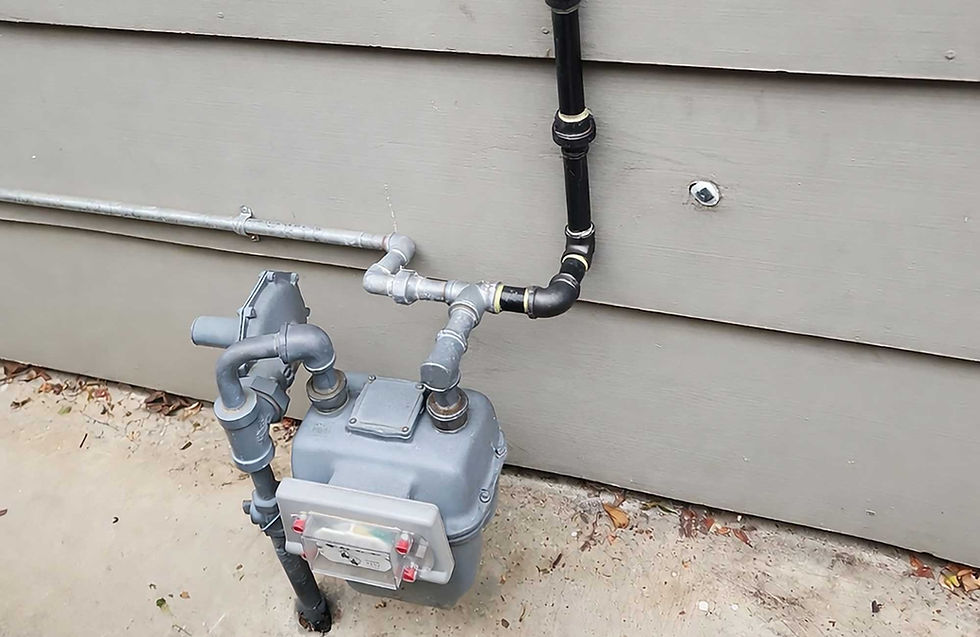
At the homeowner’s request, we rerouted the gas line overhead and abandoned the underground section entirely. The new line was installed to supply the water heater, pressure tested, and brought up to current code.
At completion:
The underground gas line was no longer in use
The overhead line supplied the water heater only
A capped tee was installed for a potential future gas appliance
This approach avoided cutting into the slab and allowed the gas system to be modernized without unnecessary disruption to the home.
It is important to note that overhead rerouting is not always possible or appropriate. Each home must be evaluated individually based on layout, access, and usage. When conditions allow, however, it can be a clean and flexible solution.
Planning Ahead, Even When It Is Not Required
During the reroute, our technician installed a capped tee for a potential future gas connection. At the time, there was no confirmed plan to add additional gas appliances. The tee was added simply as a precaution, allowing easier expansion without having to modify the gas line again later.
Shortly after this work was completed, the homeowner decided to move forward with installing a new HVAC system. Because the gas tee was already in place, the HVAC contractor was able to connect without reopening walls or reworking the gas piping.
This type of forward thinking can save homeowners time, cost, and disruption, even when future plans are still in the early planning stages.
Addressing Unused Wall Heaters Over Time
This home originally had two gas-fed wall heaters, neither of which was in use.
Several years earlier, in 2022, we removed and patched the first wall heater as part of the homeowner’s effort to modernize the home and eliminate unused gas appliances. When it came time to remove the second wall heater and address the gas leak, the homeowner contacted us again.
During this visit, the remaining wall heater was fully removed and decommissioned. The gas supply was properly capped, and the wall opening was patched with drywall.
Removing unused or outdated gas appliances is often an important step in simplifying gas systems and improving overall safety in older homes.
Takeaways for Homeowners
If you live in a slab foundation home and suspect a gas issue, a few important points are worth keeping in mind:
Gas odors should always be taken seriously, even if they seem minor or intermittent
Slab foundations can complicate access to gas lines beneath the home
Overhead gas rerouting may be a viable alternative in some situations
Planning for future upgrades during a repair can help avoid repeat work later
Long-term relationships with a trusted contractor often lead to better outcomes
Every home is different. The right solution depends on layout, materials, and long-term plans.
If you have questions about gas piping in your home or want to understand your options before making a decision, we are always happy to walk through what makes sense and what does not.